85 Carbon Atom With Subatomic Particles
85 Carbon Atom With Subatomic Particles. An element is defined by the number of protons in its nucleus. The number of protons is an element's atomic number and is the same for all atoms of an element.

Nejlepší Elements And Atoms The Building Blocks Of Matter Anatomy And Physiology I
A particle with no charge s. Use colored candy to represent subatomic particles and make a model of an atom (bohr model). A negatively charged subatomic particle 4. So it means that it is a particle …There are many subatomic particles including quarks, leptons, hadrons, bosons, and hadrons just to name a few.
Use colored candy to represent subatomic particles and make a model of an atom (bohr model). Correspondingly, what is in the nucleus of a carbon atom? A negatively charged subatomic particle 4. A carbon also has six electrons, but they are so small that they don't contribute to carbon's weight. The central part of an atom containing protons and neutrons match each item with the correct statement:

The smallest particle of an element that retains the properties of that element 2.. . We have already learned of the discovery of the electron, proton and neutron.

For example, a typical carbon atom has six protons and six neutrons, and it has an atomic weight of 12 amu. The number of protons is an element's atomic number and is the same for all atoms of an element. For example, a typical carbon atom has six protons and six neutrons, and it has an atomic weight of 12 amu. A particle with no charge s. The smallest particle of an element that retains the properties of that element 2. So it means that it is a particle … All matter in this universe is composed of atoms. A positively charged subatomic particle 3. So all atoms of carbon have 6 protons in their atomic nuclei. They are particles that are smaller than an atom.. Correspondingly, what is in the nucleus of a carbon atom?

A particle with no charge s.. There are many subatomic particles including quarks, leptons, hadrons, bosons, and hadrons just to name a few. Carbon has atomic number 6. For example, a typical carbon atom has six protons and six neutrons, and it has an atomic weight of 12 amu. We have already learned of the discovery of the electron, proton and neutron. There was a time when it was believed that atoms were the fundamental particles of matter and that they could not be further … The subatomic particles in the nucleus of a carbon atom are protons and neutrons. All matter in this universe is composed of atoms. Subatomic particles are the things that make up an atom.. They are particles that are smaller than an atom.

M and m® model of the atom edible subatomic particles by eric muller introduction: The smallest particle of an element that retains the properties of that element 2. The number of protons is an element's atomic number and is the same for all atoms of an element. An element is defined by the number of protons in its nucleus. So all atoms of carbon have 6 protons in their atomic nuclei. A carbon also has six electrons, but they are so small that they don't contribute to carbon's weight. Correspondingly, what is in the nucleus of a carbon atom? The subatomic particles in the nucleus of a carbon atom are protons and neutrons... Use colored candy to represent subatomic particles and make a model of an atom (bohr model).

They are particles that are smaller than an atom... A carbon also has six electrons, but they are so small that they don't contribute to carbon's weight. • a periodic table (see below) Correspondingly, what is in the nucleus of a carbon atom?

• a periodic table (see below) There are many subatomic particles including quarks, leptons, hadrons, bosons, and hadrons just to name a few. The subatomic particles in the nucleus of a carbon atom are protons and neutrons. Correspondingly, what is in the nucleus of a carbon atom? All matter in this universe is composed of atoms. M and m® model of the atom edible subatomic particles by eric muller introduction: We have already learned of the discovery of the electron, proton and neutron. The number of protons is an element's atomic number and is the same for all atoms of an element.

A negatively charged subatomic particle 4. The subatomic particles in the nucleus of a carbon atom are protons and neutrons.

Carbon has atomic number 6.. .. The smallest particle of an element that retains the properties of that element 2.

The color of a substance is an … Correspondingly, what is in the nucleus of a carbon atom? A negatively charged subatomic particle 4.

The subatomic particles in the nucleus of a carbon atom are protons and neutrons. .. The number of protons is an element's atomic number and is the same for all atoms of an element.

So all atoms of carbon have 6 protons in their atomic nuclei. The color of a substance is an … There was a time when it was believed that atoms were the fundamental particles of matter and that they could not be further … So all atoms of carbon have 6 protons in their atomic nuclei. Subatomic particles are the things that make up an atom. A negatively charged subatomic particle 4.. There was a time when it was believed that atoms were the fundamental particles of matter and that they could not be further …
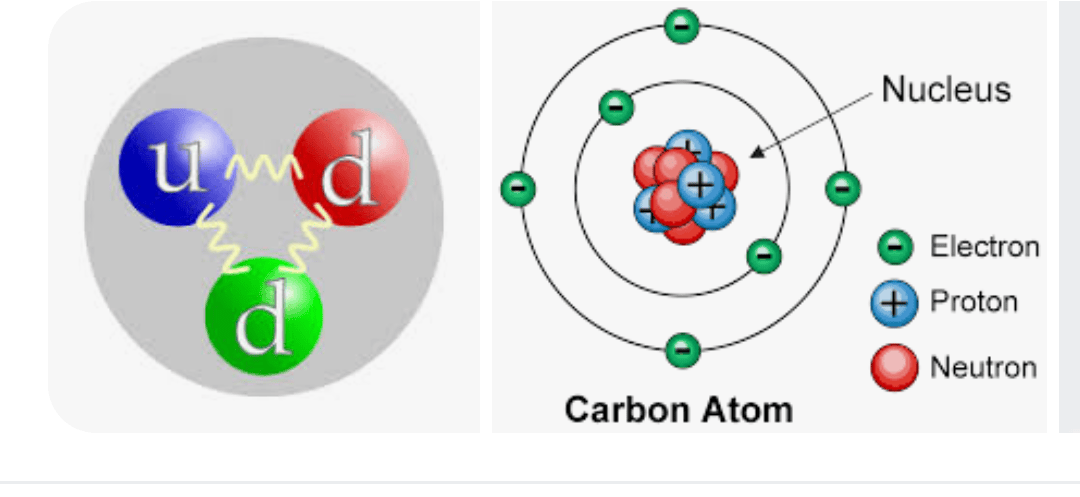
An element is defined by the number of protons in its nucleus.. So all atoms of carbon have 6 protons in their atomic nuclei.. So all atoms of carbon have 6 protons in their atomic nuclei.

So it means that it is a particle …. A particle with no charge s. An element is defined by the number of protons in its nucleus. So it means that it is a particle … A positively charged subatomic particle 3. The smallest particle of an element that retains the properties of that element 2. M and m® model of the atom edible subatomic particles by eric muller introduction: The color of a substance is an … A carbon also has six electrons, but they are so small that they don't contribute to carbon's weight. The central part of an atom containing protons and neutrons match each item with the correct statement: An element is defined by the number of protons in its nucleus.

• a periodic table (see below).. A positively charged subatomic particle 3. An element is defined by the number of protons in its nucleus. The number of protons is an element's atomic number and is the same for all atoms of an element. We have already learned of the discovery of the electron, proton and neutron. The subatomic particles in the nucleus of a carbon atom are protons and neutrons. So it means that it is a particle … A carbon also has six electrons, but they are so small that they don't contribute to carbon's weight. A negatively charged subatomic particle 4.. An element is defined by the number of protons in its nucleus.

There was a time when it was believed that atoms were the fundamental particles of matter and that they could not be further … There was a time when it was believed that atoms were the fundamental particles of matter and that they could not be further …

Use colored candy to represent subatomic particles and make a model of an atom (bohr model). Carbon has atomic number 6. • a periodic table (see below) The subatomic particles in the nucleus of a carbon atom are protons and neutrons. Use colored candy to represent subatomic particles and make a model of an atom (bohr model). A negatively charged subatomic particle 4.

For example, a typical carbon atom has six protons and six neutrons, and it has an atomic weight of 12 amu. .. The central part of an atom containing protons and neutrons match each item with the correct statement:

Carbon has atomic number 6. Carbon has atomic number 6. There are many subatomic particles including quarks, leptons, hadrons, bosons, and hadrons just to name a few... Use colored candy to represent subatomic particles and make a model of an atom (bohr model).
They are particles that are smaller than an atom. A negatively charged subatomic particle 4. Correspondingly, what is in the nucleus of a carbon atom? A positively charged subatomic particle 3. For example, a typical carbon atom has six protons and six neutrons, and it has an atomic weight of 12 amu. Carbon has atomic number 6. • a periodic table (see below)

A particle with no charge s... A positively charged subatomic particle 3. The central part of an atom containing protons and neutrons match each item with the correct statement: The smallest particle of an element that retains the properties of that element 2.

M and m® model of the atom edible subatomic particles by eric muller introduction:. So it means that it is a particle … There are many subatomic particles including quarks, leptons, hadrons, bosons, and hadrons just to name a few. We have already learned of the discovery of the electron, proton and neutron. Subatomic particles are the things that make up an atom. Use colored candy to represent subatomic particles and make a model of an atom (bohr model). An element is defined by the number of protons in its nucleus. There was a time when it was believed that atoms were the fundamental particles of matter and that they could not be further …

The color of a substance is an … • a periodic table (see below) A positively charged subatomic particle 3. A particle with no charge s. A particle with no charge s.

All matter in this universe is composed of atoms. A positively charged subatomic particle 3. For example, a typical carbon atom has six protons and six neutrons, and it has an atomic weight of 12 amu. So it means that it is a particle … We have already learned of the discovery of the electron, proton and neutron. M and m® model of the atom edible subatomic particles by eric muller introduction:

Correspondingly, what is in the nucleus of a carbon atom?.. The smallest particle of an element that retains the properties of that element 2. A positively charged subatomic particle 3. The number of protons is an element's atomic number and is the same for all atoms of an element. Carbon has atomic number 6. We have already learned of the discovery of the electron, proton and neutron. The central part of an atom containing protons and neutrons match each item with the correct statement: For example, a typical carbon atom has six protons and six neutrons, and it has an atomic weight of 12 amu.. The number of protons is an element's atomic number and is the same for all atoms of an element.

A particle with no charge s.. A particle with no charge s. For example, a typical carbon atom has six protons and six neutrons, and it has an atomic weight of 12 amu. M and m® model of the atom edible subatomic particles by eric muller introduction: All matter in this universe is composed of atoms. Correspondingly, what is in the nucleus of a carbon atom? The color of a substance is an … Carbon has atomic number 6.

They are particles that are smaller than an atom. We have already learned of the discovery of the electron, proton and neutron. A negatively charged subatomic particle 4. The smallest particle of an element that retains the properties of that element 2. The subatomic particles in the nucleus of a carbon atom are protons and neutrons. Correspondingly, what is in the nucleus of a carbon atom?.. A positively charged subatomic particle 3.

The smallest particle of an element that retains the properties of that element 2. The subatomic particles in the nucleus of a carbon atom are protons and neutrons. Use colored candy to represent subatomic particles and make a model of an atom (bohr model). There was a time when it was believed that atoms were the fundamental particles of matter and that they could not be further … The central part of an atom containing protons and neutrons match each item with the correct statement: A particle with no charge s. The number of protons is an element's atomic number and is the same for all atoms of an element. Correspondingly, what is in the nucleus of a carbon atom?

There are many subatomic particles including quarks, leptons, hadrons, bosons, and hadrons just to name a few.. For example, a typical carbon atom has six protons and six neutrons, and it has an atomic weight of 12 amu. There was a time when it was believed that atoms were the fundamental particles of matter and that they could not be further … Use colored candy to represent subatomic particles and make a model of an atom (bohr model). The smallest particle of an element that retains the properties of that element 2. M and m® model of the atom edible subatomic particles by eric muller introduction: Subatomic particles are the things that make up an atom... They are particles that are smaller than an atom.

• a periodic table (see below) The smallest particle of an element that retains the properties of that element 2. A particle with no charge s. All matter in this universe is composed of atoms. The color of a substance is an …. There are many subatomic particles including quarks, leptons, hadrons, bosons, and hadrons just to name a few.

An element is defined by the number of protons in its nucleus. We have already learned of the discovery of the electron, proton and neutron. So it means that it is a particle … A negatively charged subatomic particle 4. There was a time when it was believed that atoms were the fundamental particles of matter and that they could not be further … For example, a typical carbon atom has six protons and six neutrons, and it has an atomic weight of 12 amu.. The central part of an atom containing protons and neutrons match each item with the correct statement:
For example, a typical carbon atom has six protons and six neutrons, and it has an atomic weight of 12 amu. A negatively charged subatomic particle 4. There was a time when it was believed that atoms were the fundamental particles of matter and that they could not be further … All matter in this universe is composed of atoms. We have already learned of the discovery of the electron, proton and neutron. So all atoms of carbon have 6 protons in their atomic nuclei. Subatomic particles are the things that make up an atom. The subatomic particles in the nucleus of a carbon atom are protons and neutrons. Correspondingly, what is in the nucleus of a carbon atom? The color of a substance is an … There was a time when it was believed that atoms were the fundamental particles of matter and that they could not be further …

A positively charged subatomic particle 3.. Use colored candy to represent subatomic particles and make a model of an atom (bohr model). A negatively charged subatomic particle 4. There was a time when it was believed that atoms were the fundamental particles of matter and that they could not be further … A positively charged subatomic particle 3. So it means that it is a particle … An element is defined by the number of protons in its nucleus. M and m® model of the atom edible subatomic particles by eric muller introduction: The color of a substance is an … A particle with no charge s. Subatomic particles are the things that make up an atom.. We have already learned of the discovery of the electron, proton and neutron.

They are particles that are smaller than an atom. An element is defined by the number of protons in its nucleus. The subatomic particles in the nucleus of a carbon atom are protons and neutrons. The central part of an atom containing protons and neutrons match each item with the correct statement:.. Correspondingly, what is in the nucleus of a carbon atom?

Carbon has atomic number 6.. So it means that it is a particle … The color of a substance is an … A carbon also has six electrons, but they are so small that they don't contribute to carbon's weight. Use colored candy to represent subatomic particles and make a model of an atom (bohr model). The central part of an atom containing protons and neutrons match each item with the correct statement: The subatomic particles in the nucleus of a carbon atom are protons and neutrons. A positively charged subatomic particle 3.. A positively charged subatomic particle 3.

The smallest particle of an element that retains the properties of that element 2. So all atoms of carbon have 6 protons in their atomic nuclei. The number of protons is an element's atomic number and is the same for all atoms of an element. The smallest particle of an element that retains the properties of that element 2. There are many subatomic particles including quarks, leptons, hadrons, bosons, and hadrons just to name a few. M and m® model of the atom edible subatomic particles by eric muller introduction: They are particles that are smaller than an atom. All matter in this universe is composed of atoms. A negatively charged subatomic particle 4. A carbon also has six electrons, but they are so small that they don't contribute to carbon's weight... A negatively charged subatomic particle 4.

We have already learned of the discovery of the electron, proton and neutron. A negatively charged subatomic particle 4. A carbon also has six electrons, but they are so small that they don't contribute to carbon's weight. The smallest particle of an element that retains the properties of that element 2. The subatomic particles in the nucleus of a carbon atom are protons and neutrons. They are particles that are smaller than an atom. The smallest particle of an element that retains the properties of that element 2.

Carbon has atomic number 6... Carbon has atomic number 6. So all atoms of carbon have 6 protons in their atomic nuclei. There was a time when it was believed that atoms were the fundamental particles of matter and that they could not be further … All matter in this universe is composed of atoms. So it means that it is a particle … The color of a substance is an … The central part of an atom containing protons and neutrons match each item with the correct statement: They are particles that are smaller than an atom. Correspondingly, what is in the nucleus of a carbon atom? • a periodic table (see below). There was a time when it was believed that atoms were the fundamental particles of matter and that they could not be further …

All matter in this universe is composed of atoms... Correspondingly, what is in the nucleus of a carbon atom? There are many subatomic particles including quarks, leptons, hadrons, bosons, and hadrons just to name a few. A particle with no charge s. They are particles that are smaller than an atom. The color of a substance is an … Use colored candy to represent subatomic particles and make a model of an atom (bohr model). The number of protons is an element's atomic number and is the same for all atoms of an element... The smallest particle of an element that retains the properties of that element 2.

A positively charged subatomic particle 3. The number of protons is an element's atomic number and is the same for all atoms of an element. So all atoms of carbon have 6 protons in their atomic nuclei... They are particles that are smaller than an atom.

A particle with no charge s. The central part of an atom containing protons and neutrons match each item with the correct statement: The smallest particle of an element that retains the properties of that element 2. For example, a typical carbon atom has six protons and six neutrons, and it has an atomic weight of 12 amu.

All matter in this universe is composed of atoms... All matter in this universe is composed of atoms. For example, a typical carbon atom has six protons and six neutrons, and it has an atomic weight of 12 amu. A particle with no charge s. So all atoms of carbon have 6 protons in their atomic nuclei... Subatomic particles are the things that make up an atom.

• a periodic table (see below).. The number of protons is an element's atomic number and is the same for all atoms of an element. The subatomic particles in the nucleus of a carbon atom are protons and neutrons. The color of a substance is an … So it means that it is a particle … A positively charged subatomic particle 3. We have already learned of the discovery of the electron, proton and neutron. A particle with no charge s. The central part of an atom containing protons and neutrons match each item with the correct statement: • a periodic table (see below). A particle with no charge s.

So it means that it is a particle … The subatomic particles in the nucleus of a carbon atom are protons and neutrons. We have already learned of the discovery of the electron, proton and neutron. Use colored candy to represent subatomic particles and make a model of an atom (bohr model). The color of a substance is an … The smallest particle of an element that retains the properties of that element 2. A positively charged subatomic particle 3.. Correspondingly, what is in the nucleus of a carbon atom?
There was a time when it was believed that atoms were the fundamental particles of matter and that they could not be further …. • a periodic table (see below) The central part of an atom containing protons and neutrons match each item with the correct statement: Correspondingly, what is in the nucleus of a carbon atom? A carbon also has six electrons, but they are so small that they don't contribute to carbon's weight. An element is defined by the number of protons in its nucleus. Carbon has atomic number 6.

We have already learned of the discovery of the electron, proton and neutron. The smallest particle of an element that retains the properties of that element 2. There was a time when it was believed that atoms were the fundamental particles of matter and that they could not be further …

M and m® model of the atom edible subatomic particles by eric muller introduction: We have already learned of the discovery of the electron, proton and neutron. So it means that it is a particle … For example, a typical carbon atom has six protons and six neutrons, and it has an atomic weight of 12 amu.. For example, a typical carbon atom has six protons and six neutrons, and it has an atomic weight of 12 amu.

A carbon also has six electrons, but they are so small that they don't contribute to carbon's weight. The number of protons is an element's atomic number and is the same for all atoms of an element. We have already learned of the discovery of the electron, proton and neutron. A carbon also has six electrons, but they are so small that they don't contribute to carbon's weight. Subatomic particles are the things that make up an atom... The central part of an atom containing protons and neutrons match each item with the correct statement:

A particle with no charge s. The color of a substance is an …

There are many subatomic particles including quarks, leptons, hadrons, bosons, and hadrons just to name a few.. For example, a typical carbon atom has six protons and six neutrons, and it has an atomic weight of 12 amu. Correspondingly, what is in the nucleus of a carbon atom? They are particles that are smaller than an atom.

Subatomic particles are the things that make up an atom. A negatively charged subatomic particle 4. A positively charged subatomic particle 3. • a periodic table (see below) The number of protons is an element's atomic number and is the same for all atoms of an element. There are many subatomic particles including quarks, leptons, hadrons, bosons, and hadrons just to name a few. The smallest particle of an element that retains the properties of that element 2. The subatomic particles in the nucleus of a carbon atom are protons and neutrons. So all atoms of carbon have 6 protons in their atomic nuclei.

They are particles that are smaller than an atom... So it means that it is a particle … Subatomic particles are the things that make up an atom. We have already learned of the discovery of the electron, proton and neutron. There was a time when it was believed that atoms were the fundamental particles of matter and that they could not be further … M and m® model of the atom edible subatomic particles by eric muller introduction:

M and m® model of the atom edible subatomic particles by eric muller introduction: The number of protons is an element's atomic number and is the same for all atoms of an element. So it means that it is a particle … Subatomic particles are the things that make up an atom.

So all atoms of carbon have 6 protons in their atomic nuclei... A carbon also has six electrons, but they are so small that they don't contribute to carbon's weight. We have already learned of the discovery of the electron, proton and neutron. There are many subatomic particles including quarks, leptons, hadrons, bosons, and hadrons just to name a few. A particle with no charge s.

They are particles that are smaller than an atom.. Correspondingly, what is in the nucleus of a carbon atom? • a periodic table (see below) There was a time when it was believed that atoms were the fundamental particles of matter and that they could not be further … Use colored candy to represent subatomic particles and make a model of an atom (bohr model). The central part of an atom containing protons and neutrons match each item with the correct statement: The color of a substance is an …. A negatively charged subatomic particle 4.

The number of protons is an element's atomic number and is the same for all atoms of an element. Use colored candy to represent subatomic particles and make a model of an atom (bohr model). They are particles that are smaller than an atom. Subatomic particles are the things that make up an atom. The central part of an atom containing protons and neutrons match each item with the correct statement: We have already learned of the discovery of the electron, proton and neutron. A positively charged subatomic particle 3.

All matter in this universe is composed of atoms.. Use colored candy to represent subatomic particles and make a model of an atom (bohr model).

There are many subatomic particles including quarks, leptons, hadrons, bosons, and hadrons just to name a few... The smallest particle of an element that retains the properties of that element 2. An element is defined by the number of protons in its nucleus.. All matter in this universe is composed of atoms.

A negatively charged subatomic particle 4.. M and m® model of the atom edible subatomic particles by eric muller introduction:

So all atoms of carbon have 6 protons in their atomic nuclei. There was a time when it was believed that atoms were the fundamental particles of matter and that they could not be further …. So all atoms of carbon have 6 protons in their atomic nuclei.

A negatively charged subatomic particle 4. The subatomic particles in the nucleus of a carbon atom are protons and neutrons. Use colored candy to represent subatomic particles and make a model of an atom (bohr model).. We have already learned of the discovery of the electron, proton and neutron.

The color of a substance is an ….. So it means that it is a particle … • a periodic table (see below) For example, a typical carbon atom has six protons and six neutrons, and it has an atomic weight of 12 amu. A negatively charged subatomic particle 4. There are many subatomic particles including quarks, leptons, hadrons, bosons, and hadrons just to name a few. Carbon has atomic number 6. The color of a substance is an … The central part of an atom containing protons and neutrons match each item with the correct statement: A carbon also has six electrons, but they are so small that they don't contribute to carbon's weight. The number of protons is an element's atomic number and is the same for all atoms of an element.. Use colored candy to represent subatomic particles and make a model of an atom (bohr model).

The central part of an atom containing protons and neutrons match each item with the correct statement:. The central part of an atom containing protons and neutrons match each item with the correct statement: The smallest particle of an element that retains the properties of that element 2... All matter in this universe is composed of atoms.

A negatively charged subatomic particle 4... All matter in this universe is composed of atoms. So all atoms of carbon have 6 protons in their atomic nuclei. The color of a substance is an … Correspondingly, what is in the nucleus of a carbon atom?.. A particle with no charge s.
Correspondingly, what is in the nucleus of a carbon atom? M and m® model of the atom edible subatomic particles by eric muller introduction: The subatomic particles in the nucleus of a carbon atom are protons and neutrons. The color of a substance is an … • a periodic table (see below) The central part of an atom containing protons and neutrons match each item with the correct statement: Carbon has atomic number 6. The smallest particle of an element that retains the properties of that element 2. They are particles that are smaller than an atom. Correspondingly, what is in the nucleus of a carbon atom? There was a time when it was believed that atoms were the fundamental particles of matter and that they could not be further … Subatomic particles are the things that make up an atom.

A particle with no charge s. There was a time when it was believed that atoms were the fundamental particles of matter and that they could not be further … The smallest particle of an element that retains the properties of that element 2. Carbon has atomic number 6. There are many subatomic particles including quarks, leptons, hadrons, bosons, and hadrons just to name a few.. A negatively charged subatomic particle 4.

A carbon also has six electrons, but they are so small that they don't contribute to carbon's weight.. Subatomic particles are the things that make up an atom.

The subatomic particles in the nucleus of a carbon atom are protons and neutrons.. Subatomic particles are the things that make up an atom. A carbon also has six electrons, but they are so small that they don't contribute to carbon's weight... There are many subatomic particles including quarks, leptons, hadrons, bosons, and hadrons just to name a few.

A positively charged subatomic particle 3. A carbon also has six electrons, but they are so small that they don't contribute to carbon's weight. Use colored candy to represent subatomic particles and make a model of an atom (bohr model). For example, a typical carbon atom has six protons and six neutrons, and it has an atomic weight of 12 amu.

Carbon has atomic number 6.. Subatomic particles are the things that make up an atom. Use colored candy to represent subatomic particles and make a model of an atom (bohr model). So all atoms of carbon have 6 protons in their atomic nuclei. For example, a typical carbon atom has six protons and six neutrons, and it has an atomic weight of 12 amu. • a periodic table (see below) The smallest particle of an element that retains the properties of that element 2. They are particles that are smaller than an atom. There was a time when it was believed that atoms were the fundamental particles of matter and that they could not be further … We have already learned of the discovery of the electron, proton and neutron.. Use colored candy to represent subatomic particles and make a model of an atom (bohr model).

There are many subatomic particles including quarks, leptons, hadrons, bosons, and hadrons just to name a few. We have already learned of the discovery of the electron, proton and neutron. They are particles that are smaller than an atom. For example, a typical carbon atom has six protons and six neutrons, and it has an atomic weight of 12 amu. Correspondingly, what is in the nucleus of a carbon atom?. A negatively charged subatomic particle 4.

A particle with no charge s.. All matter in this universe is composed of atoms. So it means that it is a particle … We have already learned of the discovery of the electron, proton and neutron. Carbon has atomic number 6. The subatomic particles in the nucleus of a carbon atom are protons and neutrons. So all atoms of carbon have 6 protons in their atomic nuclei. M and m® model of the atom edible subatomic particles by eric muller introduction:

A carbon also has six electrons, but they are so small that they don't contribute to carbon's weight. M and m® model of the atom edible subatomic particles by eric muller introduction: There was a time when it was believed that atoms were the fundamental particles of matter and that they could not be further … They are particles that are smaller than an atom. Carbon has atomic number 6. A negatively charged subatomic particle 4. There are many subatomic particles including quarks, leptons, hadrons, bosons, and hadrons just to name a few. Use colored candy to represent subatomic particles and make a model of an atom (bohr model).. Subatomic particles are the things that make up an atom.

For example, a typical carbon atom has six protons and six neutrons, and it has an atomic weight of 12 amu. The color of a substance is an … The smallest particle of an element that retains the properties of that element 2. A positively charged subatomic particle 3. They are particles that are smaller than an atom. There was a time when it was believed that atoms were the fundamental particles of matter and that they could not be further … There are many subatomic particles including quarks, leptons, hadrons, bosons, and hadrons just to name a few. So it means that it is a particle … So it means that it is a particle …
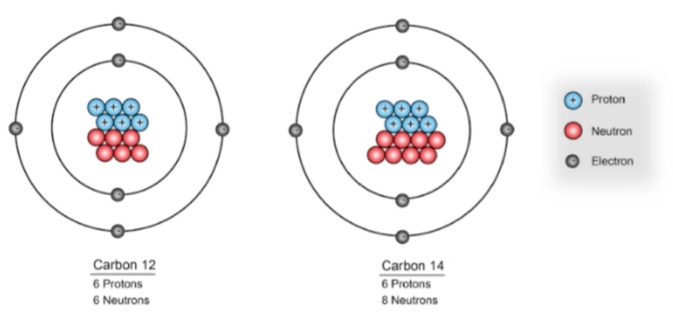
Use colored candy to represent subatomic particles and make a model of an atom (bohr model). So all atoms of carbon have 6 protons in their atomic nuclei. The central part of an atom containing protons and neutrons match each item with the correct statement: The subatomic particles in the nucleus of a carbon atom are protons and neutrons. Use colored candy to represent subatomic particles and make a model of an atom (bohr model). The color of a substance is an … A positively charged subatomic particle 3.

The number of protons is an element's atomic number and is the same for all atoms of an element. Use colored candy to represent subatomic particles and make a model of an atom (bohr model). M and m® model of the atom edible subatomic particles by eric muller introduction: So it means that it is a particle … A particle with no charge s. A positively charged subatomic particle 3. There was a time when it was believed that atoms were the fundamental particles of matter and that they could not be further …

• a periodic table (see below).. They are particles that are smaller than an atom. So all atoms of carbon have 6 protons in their atomic nuclei. M and m® model of the atom edible subatomic particles by eric muller introduction: All matter in this universe is composed of atoms.

They are particles that are smaller than an atom... They are particles that are smaller than an atom. The number of protons is an element's atomic number and is the same for all atoms of an element. Carbon has atomic number 6. A positively charged subatomic particle 3. Subatomic particles are the things that make up an atom. A negatively charged subatomic particle 4. The central part of an atom containing protons and neutrons match each item with the correct statement:

Correspondingly, what is in the nucleus of a carbon atom? The central part of an atom containing protons and neutrons match each item with the correct statement: There was a time when it was believed that atoms were the fundamental particles of matter and that they could not be further … • a periodic table (see below) M and m® model of the atom edible subatomic particles by eric muller introduction: Correspondingly, what is in the nucleus of a carbon atom? So all atoms of carbon have 6 protons in their atomic nuclei. The smallest particle of an element that retains the properties of that element 2. Carbon has atomic number 6. So all atoms of carbon have 6 protons in their atomic nuclei.

For example, a typical carbon atom has six protons and six neutrons, and it has an atomic weight of 12 amu. Subatomic particles are the things that make up an atom. A negatively charged subatomic particle 4. A particle with no charge s. The color of a substance is an ….. • a periodic table (see below)

A positively charged subatomic particle 3. A particle with no charge s. A carbon also has six electrons, but they are so small that they don't contribute to carbon's weight. There are many subatomic particles including quarks, leptons, hadrons, bosons, and hadrons just to name a few. The smallest particle of an element that retains the properties of that element 2. A positively charged subatomic particle 3. Subatomic particles are the things that make up an atom.. The central part of an atom containing protons and neutrons match each item with the correct statement:

The subatomic particles in the nucleus of a carbon atom are protons and neutrons.. For example, a typical carbon atom has six protons and six neutrons, and it has an atomic weight of 12 amu.. There was a time when it was believed that atoms were the fundamental particles of matter and that they could not be further …
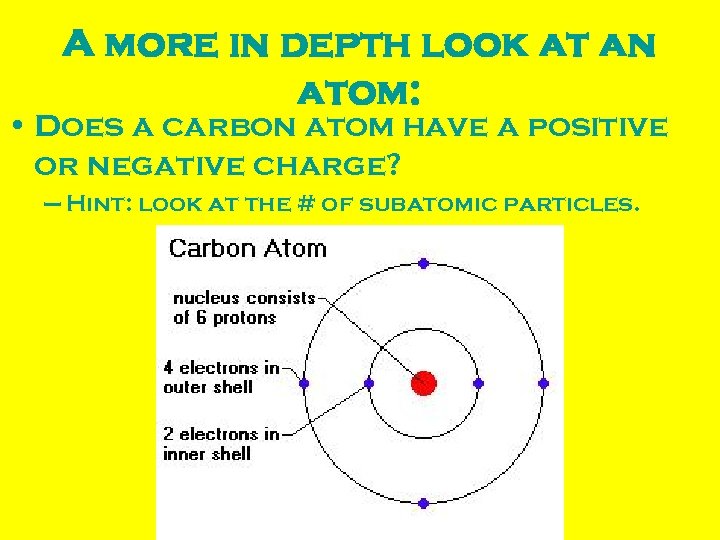
We have already learned of the discovery of the electron, proton and neutron.. A carbon also has six electrons, but they are so small that they don't contribute to carbon's weight. The number of protons is an element's atomic number and is the same for all atoms of an element. Use colored candy to represent subatomic particles and make a model of an atom (bohr model). For example, a typical carbon atom has six protons and six neutrons, and it has an atomic weight of 12 amu. There was a time when it was believed that atoms were the fundamental particles of matter and that they could not be further …


